Wish You All a very very Happy New Year 2012

Coming up the exclusive Fly Peace Campaign... to know more details contact 9983762103
Showing posts with label Taazaa Khabar. Show all posts

Monday, May 23, 2011

Protest Against AFSPA: Vapas Lo!

Dozens of PJI volunteers joined the protest against the Armed Forces Special Powers Act, organized by PUCL yesterday. We gathered at Albert Hall at six o'clock to begin the protest, and together with the public we watched a street theater performance by members of PUCL on this topic. Afterward, all the protesters marched together down JLN Marg, shouting our slogans of peace and handing out information about AFSPA to onlookers.

AFPSA is used in the North East and Kashmir to allow the military to engage in undemocratic activities. It gives them the right to arrest anyone suspected of being a separatist or insurgent, and even to kill based on suspicion. There have been many high-profile cases of military brutality as a result of this law. Iron Sharmila, an activist from Manipur, has been fasting for over ten years in an attempt to persuade the government to overturn AFSPA.

This issue has come to Jaipur via the play "Le Mashale", a one-person show performed by Ojas in many locations throughout the city. PJI helped to host and publicize these performances. More recently, PJI volunteer Shyam Bansal was instrumental in planning this protest with PUCL and mobilizing our members to join the movement.

Tuesday, May 10, 2011

Gender Workshop

PJI hosted an eye-opening workshop on gender, perceptions, and stereotypes yesterday. We were lucky enough to host a pair of young activists who designed this innovative program, Nandan Latwal and Sundeep Choudhary. They have also worked with the comMutiny Youth Collective and Pravah Delhi. About 20 PJI volunteers attended the session and came away with many new learnings and reflections on the topic.

The session started with participants being asked to express themselves on a sheet of paper, and then try doing so while imagining themselves to be another gender. Afterward, the workshop moved on to discussing various gender stereotypes with the use of creative short films on the topic.

We discussed what sorts of expectations and identities we are given as a result of our gender--things like, "you are a boy, so you should focus your career on earning for a family," or "you are a girl, so you can't stay out late or speak too loudly." We also got an education on the difference between gender and sexuality, the various genders that exist, and other clarifications on this important topic.

"In a place like Jaipur, where the gender issues are very untouched, it was actually very moving for us to see the individuals participating in the entire process," said Nandan. "It's a very serious issue, which is generally not talked about, so we should promote such efforts."

The volunteers who participated in the workshop learned a lot. Keshav Modi said that he had been unclear about different terms, including transgender, and understood better after the session. "I always thought boys are just lucky, but seeing the films and having spoken about the topic, I realize that there are expectations and difficulties for guys as well," said Shivangi Dadich during the workshop.

We want to thank Sundeep and Nandan for enlightening us on this topic and hope to continue engaging on this important issue in the future!

Tuesday, April 26, 2011

"My Body is My Weapon": Review of Le Mashale


“Le Mashale” is unconventional, high on emotions, an out and out amazing rhetoric which initially takes the audience away from the closed theater dome to gracious lands of Manipur, thanks to the beautiful descant by artist about the natural beauty, people and culture of the this state in north-eastern part of India.
And in the later half, the very confident and talented actor swiftly changes the mood. Assembly of viewers walks down the roads of Manipur once again, but to everyone’s astonishment, this time they only see painful feminine screeches, small ponds of blood and unspeakably horrendous accounts of human-to-human abuse.
I feel there are 2 particular reasons for which “Le Mashale” befalls in the ‘must watch’ category:
A) It touches that part of India which may be politically integrated with the country, but certainly has a long way to go before it earns acceptance and brotherly affection from mainland India. The play also opens numerous chapters in life of Manipuris, including the sufferings as by-product of a draconian law named AFSPA. I believe this single play can be very important in initiating a much-delayed and much-needed country wide debate on whether AFSPA has any value in some North-east regions of India and could it be made a bit more flexible/liberal eyeing current situation.

B) Second reason is undoubtedly Ojas S.V., the lone actor of “Le Mashale.” In my 3 years of indulgence to theatrical drama, only few performances could move me. This was one. This young girl from Pune, with the backing of an unscribbled script, makes you believe in the end that you have observed life of Irom Sharmila at close hand, even if it’s only the first instance one has ever heard of her. (Personally the scene involving vigorous stuttering of newspaper portraying the plight of a tormented woman took me away completely.) I also sense that immense potential of soliloquy as a medium of drama is yet to be discovered by major theatrical stakeholders.

My regards to the Iron Lady of Manipur and wish she becomes Iron Lady of India too.
 -Siddhant Nowlakha

Monday, April 25, 2011

Le Mashale Comes to Jaipur

We have been lucky enough to host the performer Ojas as she has come to Jaipur to perform Le Mashale, her remarkable play about the famous activist Irom Sharmila and her decade-long fast to bring justice to Manipur.

The play is a one-person performance which uses drama, multimedia, and other elements to tell this important story. Irom Sharmila has been fasting for over ten years to protest the AFSPA and other unjust elements of the armed forces' actions in Manipur.

Ojas, a native of Pune, has been performed this play over 90 times, in all regions of India. She has spent the past week in Jaipur to spread this story and message to audiences throughout the city. PJI, in collaboration with PUCL, Sarthak, and Sangram has facilitated performances in IIIM, SWRC Tilonia, Sankskar School, JKK, MGD School, and SV Public School from April 22nd-25th. Jaiveer, Ashutosh, Abhishek, and Akshay worked intensively to make these performances possible.

The performance has generated rave reviews and taught many people new things about this important issue. Information about acts of violence and brutality by the Indian military has been spread in this innovative manner, and has led to many audience members adopting new viewpoints about the topic.

Ritansh Pandey, a PJI volunteer, said "The play was really nice and really touching. We got to many things about the northeast that we never knew before, things that are not covered by the media. We got to know the really inspiring and touching story of Irom Sharmila, and it inspired us to join hands for the movement."


PJI has also facilitated question-and-answer sessions and discussions with Ojas after many of the performances. These discussions have allowed audience members to learn even more about the conflict and better understand different aspects of the performance.

Monday, April 18, 2011

Visit to Gurudwara and Our Seva in Society

A group of 15 PJI volunteers visited the Guru Nanak Pura Gurudwara in Raja Park last week, on April 14th, for the Sikh festival of Baisakhi! We joined crowds of attendees to perform seva, helping to prepare food and clean the cooking area. We  also sat down for a langar, sharing a meal of roti, daal, sabji, and halvah with the hundreds of others in attendance.


After the visit, the group sat down for a discussion. Many volunteers talked about new experiences they had at the Gurudwara, and we all learned about the concepts and symbols of Sikhism. We spoke for a while about the ideas of seva and langar, and how these relate to the religion.


The discussion progressed towards the idea of looking at things that all religions share (like attitudes of service and sharing), and how this can sometimes be more important than just focusing on the differences between them. Very similar is a concept from the Self-Awareness Workshop--that we actually share 95% similarities in personality and ideas between people, but we spend so much time on just the 5% differences. This also led into a talk about how we can perform seva in society as a whole.


Our trip and discussion were very valuable in terms of learning new things and further exploring concepts that we've already known. PJI hopes to continue exploring diversity with sessions on different religions and other groups.

Wednesday, April 6, 2011

Bhangra at PJI!

PJI held an Open Space meeting yesterday to learn Bhangra dancing from our facilitator and expert Mr. Tejpal Dhillon!

Around 30 members packed the cafe to learn some new steps and learn about Punjab from Tej and Maneesha. Tej is a Bhangra competitor who was brought up in the U.S. but has family roots in Punjab. He taught us all a number of Bhangra moves, told us about the origins of the dance style, and led us in dancing to his personal Bhangra tracks.

After the Bhangra, we sat together and learned a little about the state of Punjab from Tej and Maneesha. We also discussed upcoming PJI events and awarded certificates to all of those who donated blood as part of last month's "Save Life By a Drop" blood donation camp.

Thanks to Tej and everyone who came to make the event such a success. And let us know what you thought about the Bhangra!

Wednesday, March 30, 2011

Open Space on issue of Molestation

PJI's Open Space was held on Tuesday on the issue of female molestation in India. Volunteers came to discuss this important issue, as well as watch a private screening of the film "Garima" on this topic, with a special discussion with the filmmaker Mr. Rajpal Singh. The members learned a lot about this issue and discussed many possible solutions for addressing it in the future.

The Open Space started with a screening of the 30-minute film which focuses on the topic of female molestation. Afterwards, Mr. Rajpal led a discussion of many different aspects of this issue: the role of media, the role of family and society, and various factors in the workplace. Additionally, we spoke about various causes that lead to this problem, and the different types of molestation (physical, mental) that can occur.

Other volunteers shared some of their own experiences dealing with this issue, and offered their own opinions. Some raised the concern that it is not always possible to stop this from happening whenever we see it, depending on the circumstances. We discussed more fundamental solutions, such as: females being more vocal about these issues, talking about the importance of this issue with small children, and male college students working to create a safety net around their female friends. One volunteer spoke about potentially starting an action project to educate people in her college about this issue, and others discussed researching the rules of judicial system.

Thursday, January 27, 2011

Republic Day Cafe Mohalla with Radha Kant Saxena

For Republic Day, Cafe Mohalla welcomed many new members to listen to Radha Kant Saxena, the  retired Director General of Rajasthan Police prisons and current Vice President of the Peoples Union for Civil Liberties. Mr. Saxena is a tireless advocate for reform of the criminal justice system, and he generously shared many of his personal experiences and views with the group to raise awareness of this important issue.

In keeping with the holiday, he centered his talk around the constitution's rights and duties towards Indian citizens. He spoke about the frequent corruption of justice seen throughout the nation today, and shared some personal stories highlighting this issue, as well as corruption in politics as a whole.

Mr. Saxena's session was also highly inspirational, as he described his faith in today's youth to tackle this problem and move the country forward on this issue. The Right To Information Act, among other tools, is essential in bringing government officials to respect their duties towards normal citizens. Perhaps most importantly, as Mr. Saxena said in reference to making progress on any social issue, "In each of us there is a Mother Teresa, it is just up to us to have the courage to live our life in that way."

Afterward, we had a question-and-answer session, and a discussion led by Meenakshi and Richa of how to bring these values into our everyday lives. Volunteers shared their own stories, with Aditi speaking about her experience working on education, and Siddhant sharing on how his views of reservations changed when he saw the other side of the story. Saurab spoke about he and other students from MNIT started an NGO called Utthan that works to educate physically and mentally challenged children.

Lastly, there was an informal chat with a group of Global Exchange Volunteers from the UK and India who are working in a village in Tiloniya, Urmul, near Jaipur, and a session explaining Cafe Mohalla and PJI to all new members. Afterward, we shared snacks and played a game of frisbee. Jaiveer announced his new action project,"Pukar--The Unheard Voices", which will document how the lives of people have been changed since the Jaipur bomb blasts of 2008. Anyone interested in being a part of this project can contact Jaiveer or attend the first meeting on Feb. 2nd at 1 pm.

In all, the Republic Day Cafe was a huge success. Bhaumik, Sunil, and Meenu worked to organize all the activities, and over 50 people were in attendance.


Sunday, January 9, 2011

Fly Peace Kites makes an impact

PJI's Fly Peace Kites Campaign has been a huge success over the past weekend, as the campaign has visited different colleges, NGOs, and public spaces around Jaipur, and young people in attendance have taken notice of this creative campaign for peace. Through theater, music, kite flying, and other innovative mediums, the volunteer group has effectively started a conversation about peace in society among thousands of young people in the city.


With recent visits to Maharani College, ICG, MNIT, LBS College, Guarav Towers, and Faith NGO, large crowds have come to enjoy the different parts of the event. The street theater skit, which is about the meaning of peace among each different level of society, including the home and family, has been a huge hit. The original compositions by Ritansh, Shevang, and Karan also took the message of peace and explored it through experimentation and mixing of different genres, and their performances have been a big hit at every venue.

The use of kites to spread this message has been a big success as well, as thousands of kites with different peace messages have been written and flown around Jaipur. The PJI campaigners have used the kites to provoke thought about this complicated topic and record the thoughts of many young people from different backgrounds and communities.

We invite you to join us as this campaign continues at Umang NGO and IIRM tomorrow, for the final day. The event at IIRM will be from 1 to 3 pm. Come and be a part of the movement towards peace!

Monday, December 13, 2010

Taaza Khabar: PJI Walks with Altaf Bhat Chisti

PJI Volunteers joined activist Altaf Bhat Chisti in his journey for peace this past Friday. After a number thought-provoking discussions with the Kashmiri native--who is walking from Mumbai to Delhi to campaign for peace in the Kashmir Valley--a number of PJI volunteers decided to walk a few kilometers alongside him, from Johari Bazaar to Lal Mahal in Jaipur city.

Altaf was 18 years old when he was picked up by terrorist groups and sent to a terrorist training camp in Pakistan-occupied Kashmir. Three months later, upon returning, he laid down his AK-47 on the border and decided to devote his life to peace. Despite facing harassment from Indian officials and serving jail time for his past activities, he still continues to believe peace is the way forward for Kashmir, and works to spread this message everyday.

Around 15 PJI volunteers walked with Altaf after hearing his story. They marched together, continuing the peace campaign and working to make sure their voices are heard.

Keshav Modi, a volunteer, said "From Altaf, I came to learn many things about Kashmir, and the problems people face in Kashmir. Previously, I had only known one side of the story about BSF, but Altaf showed me the other face too, the many instances of cruelty. After learning from Altaf, I felt I wanted to do something for the Kashmiri people, so I walked with him"

Many other volunteers felt the same way. They want to make sure that the stories of actual Kashmiris like Altaf are heard, so India can address this issue in an open dialogue and find a peaceful way forward.

Wednesday, December 8, 2010

Taazaa Khabar: Conversation with Mohammed Altaf Bhat Chisti

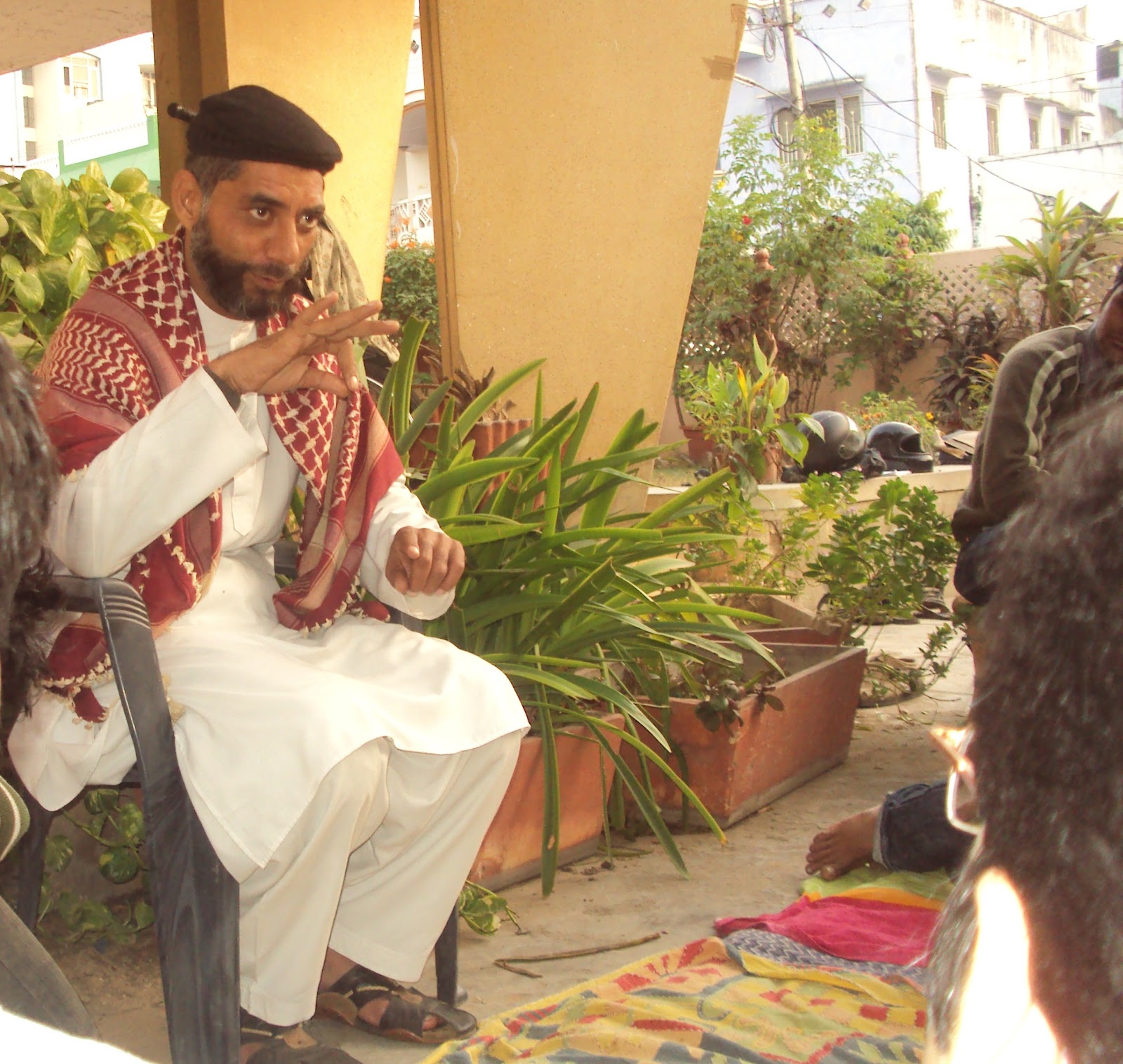
Mohammed Altaf Bhat Chisti visited PJI yesterday to share his remarkable story and a conversation with the volunteers about issues relating to his native Kashmir. He is in the middle of a peace march from Mumbai to Delhi, to spread the message of peace in Kashmir, and we had the opportunity to  learn a great deal from his personal journey and transformation.

Altaf grew up in Kashmir, and at age 18, joined Al-umar-mazuhidin, a terrorist training organization in Pakistan-occupied Kashmir. After training for 3 months, he returned to his native place and realized that using violence is not the right way to bring peace to the region. He now believes that no religion or community has the right to kill innocent people, and using terrorism as a political strategy is against humanity, religion, and law.

Since his transformation, he has worked to promote a message of peace in Jammu and Kashmir. He worked as a freelance journalist in the state for two years, but was arrested by the Border Security Force and sentenced to two years in jail. Even after being kept in Trinaga Central Jail and receiving cruel beatings by officials, he still believes peace is the way forward for the community that lives in Kashmir.

To promote this idea, he began his peace march from Mumbai on the 23rd of September, and has had conversations about these issues with people he meets along the way. He wants more people to know the real face of the Kashmiri people--what they feel and think, and what their issues and views really are.

He stopped by PJI for a tremendous conversation yesterday with around 25 volunteers, telling his story and answering countless questions. Volunteers asked about a wide range of subject: why many Kashmiri people don't want to be a citizens of an Indian state, what problems result from army occupation, and why the border is porous to terrorists. We learned a great deal about the reality of life in Kashmir, and Altaf's message for the way forward in this troubled region.

All are invited to accompany Altaf for the first kilometer of his walk to Delhi on Friday! Please meet at 2 pm, at Jama Mazid Johari Baazar. We will gather and join this heroic figure in spreading a message of peace.

Tuesday, October 26, 2010

Taazaa Khabar: Oct 17-24

This past week at PJI we hosted a Peer Educators Workshop on HIV in collaboration with the University of Rajasthan's Department of Adult and Continuing Education. We worked with 69 participants from the university to raise awareness of the HIV issue, help educate about the details, and enable young people to serve as peer educators to further spread knowledge about this disease.

HIV and AIDS are important social issues facing India, but a surprisingly large amount of educated young people lack crucial knowledge about these health concerns. The foremost goal of the workshop was to allow expert facilitators such as Mr. Pradeep Chaudhary, Ms. Kavita A. Verma, Ms. Mona Balani, and Ms. Neelima to share their knowledge about HIV with participants and dispel many of the myths associated with the disease. The workshop also included acting out HIV scenario role plays, discussions of HIV services available in Rajasthan, and talks about the various stigmas and discrimination faced by HIV-positive individuals. The potential role of youth volunteers in HIV prevention programs was an important component of empowering the participants to play an active role in solving this enormous social issue.

Coordinator Richa Sharma felt the workshop was a big success in raising the knowledge level about HIV/AIDS. "The participants had never talked about AIDS/HIV issues, so the biggest achievement was that they spoke about the issue and they raised their concerns and questions. Most of them were bachelor of education students, and they are the future teachers, so it was nice to answer their queries and they understood their responsibility to educate more people about HIV/AIDS."

The workshop included a pre-test and a post-test to evaluate the participants' existing knowledge of HIV and how much the activities were able to improve from this base. The participants demonstrated much improved knowledge about misconceptions and facts regarding the HIV issue.

Thursday, October 14, 2010

Taazaa Khabar: Oct 3-10

There was a lot of activity this past week at Pravah, highlighted by the Window to Kula Manch Workshop held in collaboration with the University of Rajasthan's Department of Adult and Continuing Education on October 9th and 10th. The workshop was a big hit, as dozens of new participants from Jaipur area colleges attended to learn more about Pravah, discuss social issues, and get ready to participate in PJI's urban volunteering programme.

The Story of Boom Mogara

After starting the workshop by sharing objectives and expectations and doing a few energizer games, we conducted an activity where workshop participants "shopped" for different social causes, discussing the relative values of social campaigns and how they related to the term "Active Citizenship." Next was a powerpoint about PJI itself, detailing all the programs, action projects, and events PJI hosts on a regular basis. The group then decided to give itself an identity, creating a dance and song:

Boom Mogara
Chima-Chima
Agaram Bagaram
Hu-too-too!

Over the rest of the day, we took part in intensive discussions about the identities we assign to ourselves and others, and how these affect the way we view society. Even after a long day, all the participants felt very positive about the experiences they'd had and the new friends they had already made, and were eager to continue on Sunday.

The next day, after a few more morning energizers, we got things going with another discussion, this time about the stereotypes we often apply to society. Each participant wrote down one stereotype, and then was put in the position of arguing against it, while other group members argued for it. The larger group discussions made for some very passionate conversations about stereotypes and what we can do to help break them down.

After a quick lunch, we went for an exposure visit at Taabar, a local NGO that works to help runaway youths in Jaipur by housing them, protecting them from exploitation, and seeking to repatriate them back to their home states. Participants from Cafe Mohalla came along for a combined visit this week. Taabar's Programme Director Rakesh Sharma gave a  talk about the NGO's operations and goals. After that, we had a few hours to spend with the youths of Taabar--playing games, chatting, and learning about eachother. This was one of the most inspiring and enjoyable parts of the workshop, and all the participants were enthused to be there.

We concluded with a discussion about various action projects we could commit to getting started, such as helping out at an elderly home, or starting a campaign to collect books for needy children. Feedback from the workshop was very positive. Many participants shared that the Taabar visit was their favorite part, as it helped them learn about the reality of homeless children in an immediate way. Others enjoyed the games and group discussions. Nearly everyone requested that the workshop would last for more days, and wanted to continue their journeys with Pravah in the future.


What's Happening in AAINA TV

In other PJI news, the Community Video Unit's Aaina TV has been hard at work on their new film. It will focus on the personal journeys of the Community Producers themselves, and will be told through a spoof of the Vikram and Beitel story. Here's a preview clip of the upcoming film:
Copyright 2010-2011 Pravah Jaipur Initiative. All rights reserved.